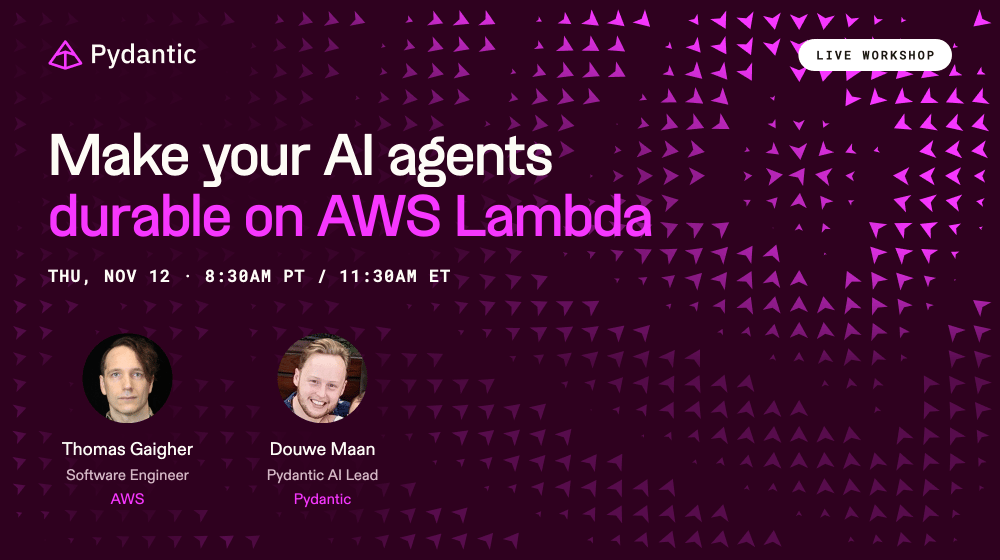
Make your AI agents durable on AWS Lambda
When an agent step fails halfway through, the whole run is usually lost. Pydantic AI now supports AWS Lambda durable functions, and this recording shows how to use them so every tool call and task becomes a durable operation that survives failures and resumes where it stopped.
Make a Pydantic AI agent survive failures and resume where it stopped, on AWS Lambda.
Overview
- 45 min
- On demand replay
- Online event
- Free
Speakers




About this recording
AI agents plan their own workflows, call tools and chain tasks together. When a step fails halfway, because of a timeout, a crashed process or a flaky API, the whole run is usually lost. For agents in production, that isn't good enough.
Pydantic AI now supports AWS Lambda durable functions as a durability provider. Every tool call and task your agent runs becomes a durable operation that can survive failures and resume where it stopped. You don't have to rewrite your agent or build your own orchestration.
In this session, Douwe Maan, lead developer of Pydantic AI, and Thomas Gaigher from AWS, who helped build the integration, take a Pydantic AI agent and make it durable on AWS Lambda. They cover where Lambda durable functions fits alongside other durability providers, then get into retries, long-running tasks and observability, with Q&A from both teams.
The code from the session is on GitHub: DouweM/pydantic-ai-aws-lambda-example.
Who it's for: Developers and engineers building reliable AI agents in production, whether you already use AWS or are evaluating serverless options.
What you'll learn
- Why agent workflows aren't durable by default, and what that costs you in production
- How durable execution works in Pydantic AI, and where Lambda durable functions fits alongside other providers
- Best practices for running durable agents on Lambda, including retries, long-running tasks and observability
Watch the recording
Tell us where to send Pydantic updates and unlock instant access to this replay.
You're all set
Your request was received. You can close this page.
We couldn't open the recording
Please go back and try again in a moment.
Explore Logfire
Explore our open source packages